
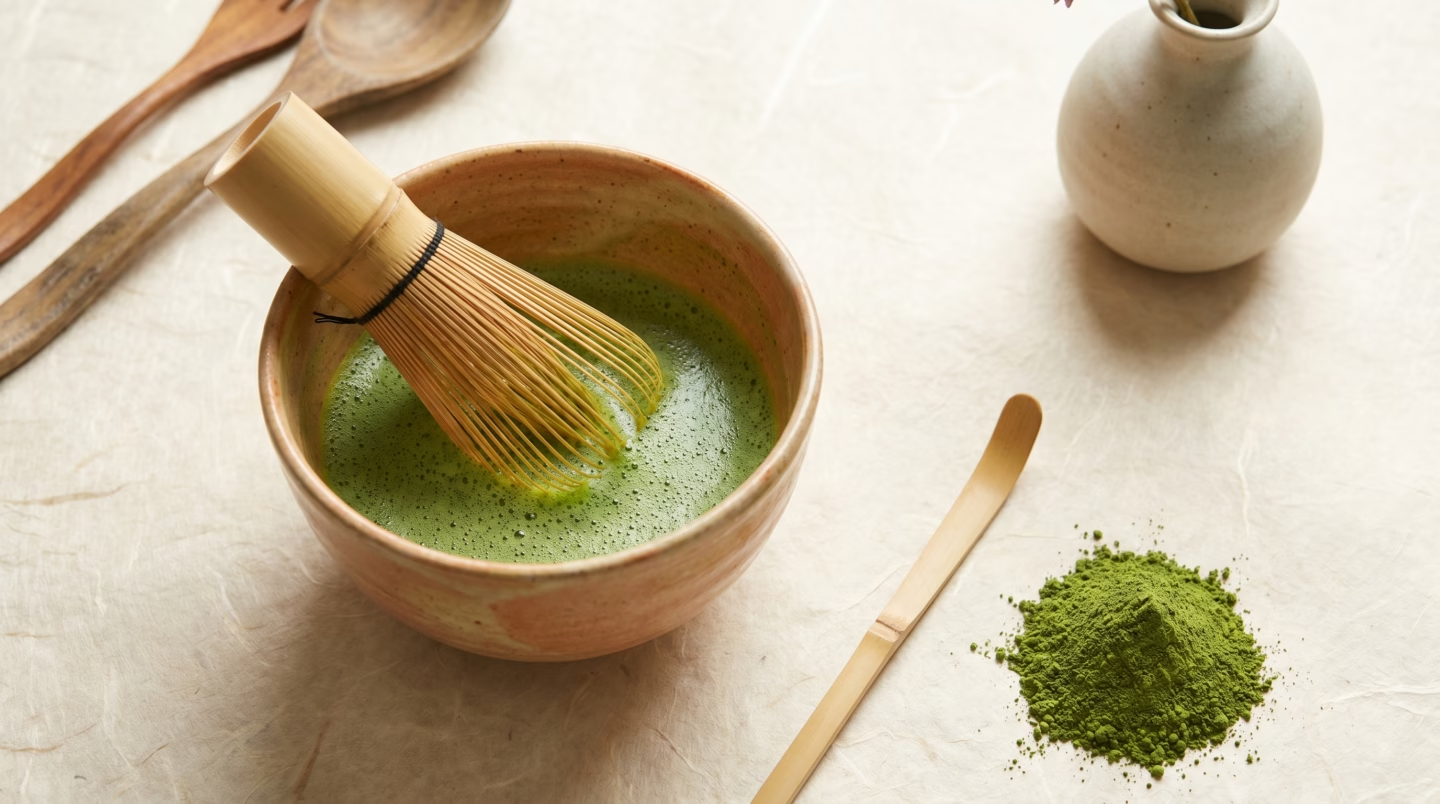
Here is the first thing worth knowing about ceremonial grade matcha: the phrase has no legal or regulatory definition anywhere in the world, and it is not a term the Japanese tea industry uses. There is no certifying body, no minimum standard, and nothing stopping any seller from printing it on any tin. That does not make the term useless — most brands do reserve it for their better product — but it means the words on the front of the package tell you far less than the specific, checkable facts printed elsewhere on it. This guide covers the four ceremonial-positioned powders in our catalog and, more importantly, the handful of label details that actually predict quality.
Our top picks at a glance
Four powders, four different reasons to pick them. Names link to our product pages, where you can review current label details before deciding.
| Pick | Best for | Notes |
|---|---|---|
| Ippodo Ummon-no-mukashi | Best traditional blend | Kyoto house with a long blending tradition; mukashi names denote a consistent house blend rather than a single field. |
| Encha Organic Ceremonial | Best certified organic | USDA Organic; first harvest from a partner farm in Uji, Kyoto. |
| Matchaful Hikari | Best single-origin option | Single estate (Hattori Tea Farm, Shizuoka); first harvest, ground to order. |
| Jade Leaf Organic Ceremonial | Best everyday choice | USDA Organic, first harvest from Uji and Kagoshima; a 30 g tin sized for daily drinking. |
None of these is objectively “the best matcha.” Ceremonial powders differ mainly in cultivar, region, harvest, and blending philosophy, and preference between them is genuinely personal.
What “ceremonial grade” actually means
Since the phrase itself is unregulated, it helps to know what the better products under that label usually have in common — and to check those things directly.
It should be made from tencha. Tencha is shade-grown leaf that has been steamed, dried without rolling, then de-stemmed and de-veined before grinding. Powders made from unshaded leaf, or from leaf with stem and vein left in, are coarser and more bitter. This is the single biggest structural difference between grades.
The plants should have been shaded. Covering the bushes for roughly three to four weeks before harvest slows photosynthesis. That raises chlorophyll, which is why good matcha is vivid green rather than olive, and raises the amino acid L-theanine relative to catechins, which is why it tastes savoury and sweet rather than sharply bitter. A dull, yellowish powder usually means little or no shading.
It should be stone-ground. Granite mills grind tencha slowly — a commonly cited figure is around 40 grams an hour — which keeps the powder cool. Heat from fast industrial grinding damages aroma compounds. Stone-ground is a claim worth looking for because it is specific and falsifiable.
First harvest matters. Ichibancha, the spring first flush, produces the sweetest, least astringent leaf. Later harvests are more astringent and are generally directed to culinary grades. Brands that use first-harvest leaf usually say so.
Ippodo Ummon-no-mukashi — Best Traditional Blend
Ippodo is a long-established Kyoto tea house, and the -no-mukashi suffix in the name is not marketing garnish — it is a traditional Japanese naming convention for a house blend. That points to something people often misunderstand about premium matcha: a blend is not a lesser product than a single origin. Blending across fields and cultivars is how a house delivers the same character year after year despite weather, and in Japanese tea culture the skill of the blender is itself the prestige signal. Ummon sits toward the richer, more concentrated end of a typical house range.
What we like is the consistency that a serious blending tradition buys you: if you find a house blend you get on with, the next tin should taste like the last one. What we do not love is that the naming conventions are opaque to newcomers — the tier structure of a Kyoto tea house is not self-explanatory from an English-language product listing, and it is easy to buy a tier above or below what you actually wanted. Read the producer’s own description of where a given name sits in their range before ordering.
- Pros: Established Kyoto producer; blend consistency across harvests; positioned for traditional preparation including thicker styles.
- Cons: Naming tiers are hard to decode from outside; premium positioning; availability of specific names varies.
Encha Organic Ceremonial — Best Certified Organic
Organic certification is one of the few claims on a matcha tin that is actually externally verified, which makes it genuinely useful. Two marks turn up on Japanese matcha: JAS, the Japanese organic standard, and USDA Organic. A product can carry one, both, or a translated equivalent, so it is worth looking at which mark is physically on the package you receive rather than assuming. Encha’s ceremonial grade combines USDA organic certification with first-harvest leaf from its partner farm in Uji, Kyoto.
What we like is that certification narrows the gap between marketing and fact: unlike “ceremonial,” it is a claim someone audits. What we do not love is a common misreading — organic certification speaks to cultivation practice, not to grade, shading duration, cultivar, or grind. An organic powder can still be a later harvest, and a non-organic powder from a careful producer can be the better tea. Treat the mark as one verified data point among several rather than a quality ranking.
- Pros: Externally audited cultivation claim; first-harvest positioning; clear labelling for buyers who prioritise organic sourcing.
- Cons: Certification does not imply grade or shading; organic lines usually carry a price premium; check which certifying mark applies to your package.
Matchaful Hikari — Best Single-Origin Option
Single-origin matcha is the newer, more Western framing of quality: name the region, sometimes the farm, sometimes the cultivar, and let the buyer build a preference around it. Japan’s main matcha regions each have a recognised character — Uji in Kyoto is the historical benchmark, Nishio in Aichi produces a large share of volume, Yame in Fukuoka is associated with rich, sweet styles, and Kagoshima in the south harvests earliest and has grown rapidly. Cultivar names such as Okumidori, Samidori, Asahi, and Yabukita appear on more transparent packaging and are a genuine signal of specificity.
What we like about this style of sourcing is that it gives you something concrete to learn from: if you discover you prefer one region or cultivar, that knowledge transfers to your next purchase in a way that “ceremonial grade” never does. What we do not love is that single origin is not automatically better — a single field has a single weather year, so batch-to-batch variation is larger than with a house blend. Matchaful names its source: the Hattori Tea Farm, a multi-generational estate in the hills of Shizuoka, with first-harvest leaf ground to order.
- Pros: Named sourcing you can learn from; more transparent than grade language alone; specificity is itself a quality signal.
- Cons: More batch-to-batch variation than a blend; origin alone does not guarantee shading, harvest, or grind quality; details can change between lots.
Jade Leaf Organic Ceremonial — Best Everyday Choice
There is a practical argument that most people over-buy matcha. Ceremonial powder is at its best within roughly a month of opening, so a tin you drink slowly because it felt expensive is a tin that is quietly going stale. A well-made, widely available organic ceremonial powder that you will actually drink daily often delivers more total enjoyment than a rarer tin you ration. Jade Leaf’s ceremonial line is positioned for exactly that role.
What we like is the accessibility — consistent availability and organic certification at a level that makes daily drinking realistic rather than an occasion. What we do not love is that sourcing from two regions, Uji and Kagoshima, makes it less traceable than a single-estate tea, even though Jade Leaf does disclose that it is first harvest and names the cultivars in its range. If you are trying to develop a preference between regions or cultivars, this is a fine everyday tin but not the most informative one.
- Pros: Realistic for daily use; organic certification; consistent availability; low barrier for a first ceremonial tin.
- Cons: Less disclosure about region, cultivar, and harvest; positioned for breadth rather than distinctiveness.
How to choose ceremonial matcha
Read the back of the tin, not the front
The front says “ceremonial.” The back — or the manufacturer’s product page — is where you find origin, harvest wording, cultivar, ingredients, and net weight. The ingredient list should read as green tea and nothing else. If sugar, milk solids, or flavourings appear, you are looking at a latte mix rather than matcha.
Judge the colour honestly
Good matcha is vivid, slightly bluish green. Yellow-brown or olive powder generally indicates unshaded leaf, later harvest, stem and vein content, or oxidation from age. This is one of the few quality checks you can perform yourself the moment you open the tin, and it is reliable.
Look for a date, not just a grade
Matcha degrades measurably with exposure to light, heat, oxygen, and humidity. A harvest date, packing date, or best-before date is more informative than any grade word. Packaging matters too: an opaque, resealable tin protects far better than a clear bag or a loose pouch.
Compare by cost per gram, not by tin
Tins vary widely in net weight, so headline comparisons are meaningless. Divide by grams, then multiply by your actual dose — around 2 g for thin tea — to get a cost per drink you can compare across products. Our matcha batch calculator does that arithmetic and shows its formulas.
Buy small first
Preference in matcha is real and personal; some people prefer the brisk, brothy character of one region and find another cloying. Buying the smallest available tin of two different powders teaches you more than one large tin of an expensive one.
Storage is half the battle
An excellent powder stored badly becomes a mediocre powder within weeks, and this is where most of the value people pay for gets lost. Keep unopened tins cold and sealed. Before opening a refrigerated tin, let it come fully to room temperature first — opening a cold tin in a warm kitchen condenses moisture onto the powder, and damp matcha clumps permanently and stales fast.
After opening, keep the tin closed, dark, dry, and away from the stove. Use a dry spoon every time. Plan to finish an opened tin within about a month; beyond that the colour dulls and the aroma flattens even if nothing has obviously gone wrong. If you are not drinking it that fast, buy smaller tins rather than storing longer.
How we evaluate
MatchaNest builds these comparisons from documentation rather than from a physical tasting programme. That means manufacturer product pages, ingredient panels, package and net-weight details, certification marks, origin and harvest wording, storage directions, and the well-documented agronomy of tencha production described above. We do not claim to have bought, prepared, or tasted every powder on this page, and we do not publish star scores that would imply we had.
Where this page describes how a category behaves — why shading raises L-theanine, why stone grinding matters, why colour indicates harvest and handling — that is established, checkable information about matcha production, not a claim about a specific tin we opened. Grade words such as ceremonial, premium, and culinary are treated as positioning, not certification. Read our editorial policy and affiliate disclosure for the full standard. Ingredients, certifications, origin wording, and availability change between lots; confirm them on the current package before you buy.
Frequently asked questions
Is ceremonial grade worth it over culinary grade?
For drinking straight, yes — the difference in bitterness and texture is large and immediately obvious. For a sweetened latte, often no. Milk proteins bind the very compounds you paid extra for, and a robust culinary or latte-positioned powder frequently comes through milk better. Our latte matcha guide covers that in detail.
Is there any official body certifying ceremonial grade?
No. There is no standards organisation, no audit, and no minimum specification behind the term in Japan, the United States, or the EU. Organic marks such as JAS and USDA Organic are audited; grade words are not.
Why does my expensive matcha taste bitter?
The most common causes are water temperature and dose, not the powder. Water at or near boiling extracts harshly; guidance for thin tea is typically around 70–80°C. Overdosing relative to water, using an unsifted powder, or drinking from an old open tin will all read as bitterness too.
Does a higher price mean better matcha?
Price correlates loosely with harvest, shading, and grinding, but it also reflects packaging, import route, brand, and organic certification. A mid-priced first-harvest powder from a transparent producer will usually beat a premium-priced tin with no origin or harvest disclosure.
How long does matcha keep once opened?
Plan on roughly a month of good drinking after opening, kept sealed, cool, dark, and dry. It does not become unsafe after that, but the colour dulls and the aroma flattens. Unopened and refrigerated, it keeps considerably longer — bring it to room temperature before opening.
The verdict
If you want the reliability of a traditional house blend, Ippodo Ummon-no-mukashi is the pick, and its consistency across harvests is a real advantage. If audited organic sourcing is your priority, Encha Organic Ceremonial gives you a claim someone actually checks. If you want to learn what you like, Matchaful Hikari and its named sourcing give you something concrete to build on. And if the honest goal is drinking good matcha every morning without rationing it, Jade Leaf Organic Ceremonial is the sensible tin. Whichever you choose, buy the smallest size first, check the colour the moment you open it, and drink it while it is fresh — that will affect your cup more than moving one tier up the price list.